Closed Cases
The full case
The essay
For seventeen years the FBI hunted a bomber it could not name. In the end he was caught by his own prose. He demanded that a newspaper print his essay, and his younger brother recognised the writing.
The manhunt cost more than fifty million dollars and at its peak employed more than one hundred fifty full-time investigators. It was one of the longest and most expensive investigations in the Bureau's history.
The man at the end of it lived in a cabin ten feet by twelve, with no electricity and no running water, in the woods of western Montana.
This is the story of the Unabomber, the brother who turned him in, and the deal that kept him alive.
The first package
In May 1978, a package was found in a parking lot at the University of Illinois in Chicago. It was taken to Northwestern University, where it exploded. One person was hurt.
More bombs followed. Universities. An American Airlines flight in November 1979, forced into an emergency landing in Washington. The home of an airline president in 1980.
The FBI formed a task force in 1979 and gave the case a code name from its targets: UNABOM, for university and airline bombing. The press turned that into a name. The Unabomber.
Investigators had little to go on. The devices were handmade, the targets seemed scattered, and the task force, more than one hundred fifty people at its height, had no name to put to them.
The sketch
In December 1985 a package left outside a computer rental store in Sacramento killed its owner, Hugh Scrutton. He was the first person to die.
In February 1987, in Salt Lake City, a witness saw a man leave a package outside a computer shop. The sketch that followed became famous: a hooded figure in sunglasses.
Then the bombs stopped. For more than six years, from 1987 to 1993, there was nothing at all.
In June 1993 they started again. Two bombs in two days, one at a geneticist's home in California, one at a computer scientist's office at Yale. Both men survived.
In December 1994 an advertising executive, Thomas Mosser, was killed at his home in New Jersey. In April 1995 Gilbert Murray, head of a forestry association, was killed in Sacramento. Sixteen bombs. Three dead. More than twenty injured.
The demand
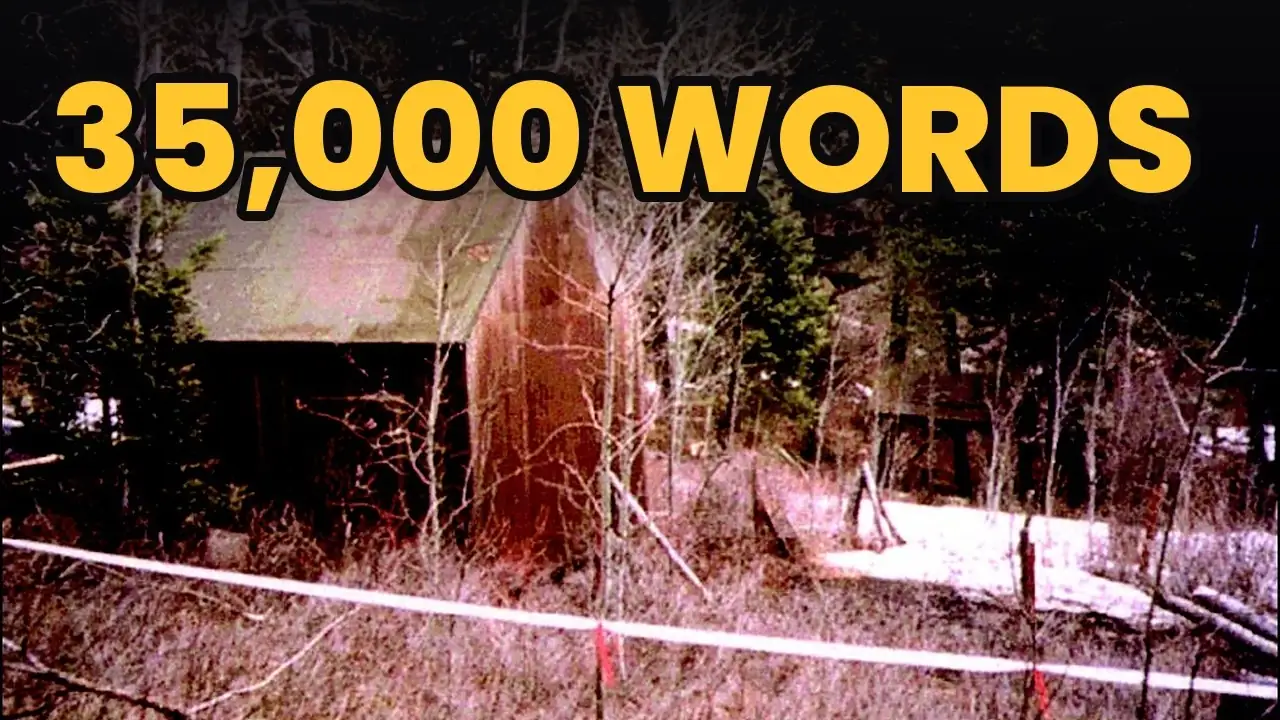
Then in June 1995 the bomber did something new. He wrote to the newspapers. A thirty-five-thousand-word essay, Industrial Society and Its Future, with a promise. Publish it, and the bombing stops.
He gave them three months. The New York Times and the Washington Post faced a choice no newspaper wants: print a killer's manifesto, or refuse and wait for the next package.
Attorney General Janet Reno backed publication, and the FBI with her. Their hope was simple. Somewhere, someone would read it and recognise the voice.
On the nineteenth of September 1995, the Washington Post printed the full text as an eight-page supplement. The two papers split the cost.
The brother
A woman named Linda Patrik read the essay and felt a chill. The ideas, the phrasing. It sounded like her husband's older brother, a brilliant recluse named Ted.
Her husband, David Kaczynski, did not want to believe it. He dug out old letters his brother had sent him over the years and set them beside the manifesto. He found the same mannerisms.
Ted Kaczynski had entered Harvard at sixteen, taken a doctorate in mathematics, and become the youngest assistant professor in the history of Berkeley. In 1969 he resigned without explanation. By 1971 he was living in a cabin outside Lincoln, Montana.
David and Linda hired a lawyer, Tony Bisceglie, to take what they had to the FBI. David asked that his name be kept secret, and that his brother be given psychiatric care.
Linguistic experts compared the letters and the essay and found a match. In early 1996, FBI agents moved quietly into the hills around Lincoln, Montana, and watched a cabin.
The cabin
On the third of April 1996, agents approached the cabin and took Ted Kaczynski into custody. Inside, they found a live bomb, ready to be mailed.
They also found bomb components, the typed original of the manifesto, and about forty thousand handwritten pages of journals describing his experiments and his crimes.
The reward for the Unabomber was one million dollars. David Kaczynski's name, which the FBI had promised to protect, leaked to the press.
David received the reward. After legal fees and taxes, he gave six hundred thirty thousand dollars of it to the people his brother had hurt and to their families.
The deal
In June 1996 a federal grand jury indicted Kaczynski on ten counts of transporting, mailing and using bombs. It was a capital case. He could be sentenced to death.
The trial in Sacramento never really began. Kaczynski tried repeatedly to fire his lawyers and represent himself. The judge refused.
On the twenty-second of January 1998, he stood in the courtroom and pleaded guilty to every federal charge. In exchange, the death penalty came off the table. Life without parole, and no appeals.
That May he was sentenced to four life terms plus thirty years, and sent to the federal supermax prison in Florence, Colorado. He later tried to withdraw the plea. The court said no.
What it changed
The case is remembered for a decision as much as an arrest. Printing a killer's demands felt like surrender. It turned out to be the trap. A former agent put it simply: the manifesto was his undoing.
David Kaczynski went on to lead a campaign against the death penalty in New York, and to work with the families of victims of violence. He has said reporting his brother was painful, but that he felt he had to, to prevent more victims.
The end
Seventeen years. Sixteen bombs. A task force of more than a hundred and fifty. And in the end, a woman reading a newspaper who recognised the way her brother-in-law put his sentences together.