Closed Cases
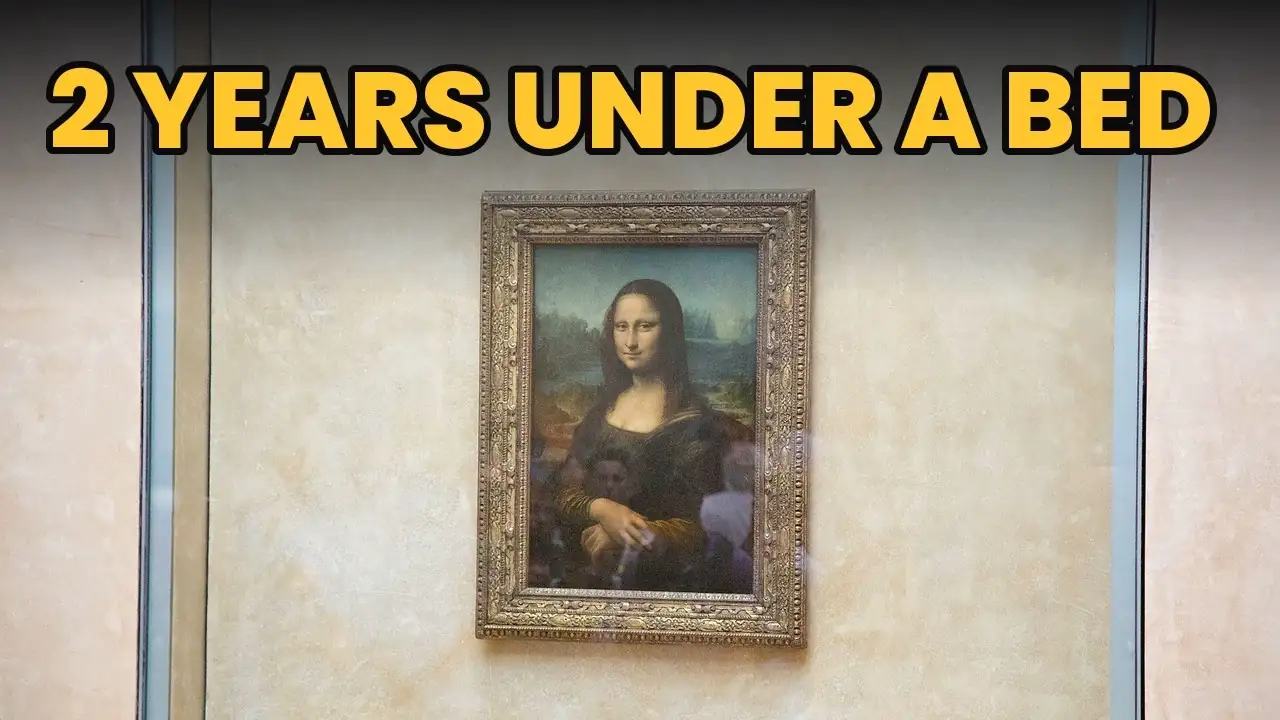
The full case
The empty wall
A locked door blocks a workman in a white smock. A museum plumber, taking him for a colleague, opens it. The workman walks out of the Louvre with the Mona Lisa under his arm. For about twenty-six hours, nobody notices she is gone.
The theft happened in August 1911, and the painting was already four hundred years old. Leonardo da Vinci painted it in Florence around 1503 and carried it to France in 1516, where King Francis the First bought it.
By 1911 it hung in the Salon Carré of the Louvre, behind glass, admired by scholars but hardly a household name. The theft would change that. And two years later, the thief himself would hand her to a museum director.
The glass case protecting it had been built by museum workmen. One of them was an Italian house painter named Vincenzo Peruggia, who knew exactly how that case came apart.
Monday morning
Monday, August twenty-first, 1911. The Louvre was closed to the public, as it was every Monday. Peruggia came in through the workers' entrance, wearing the white smock that Louvre employees wore.
When the gallery was empty, he lifted the painting off its four iron pegs and carried it to a service stairway, where he stripped off the frame and the glass case and left them on the landing.
Then he walked out, and reached that locked door. The plumber, taking him for a colleague shut in by mistake, opened it. And the Mona Lisa left the Louvre under a workman's arm.
Nobody raised the alarm. Paintings were often taken down to be photographed or cleaned, and the empty pegs looked like routine. The theft went unnoticed for about twenty-six hours.
Gone
On Tuesday a painter named Louis Béroud arrived to make a copy and asked a guard when the picture would be back. By evening the Louvre admitted that the Mona Lisa was gone.
The museum shut for about a week while police searched it. The frame and glass were found on the stairway. Borders were watched, and ships and trains searched.
The story ran in newspapers across Europe and America, most printing a reproduction of the painting. For millions of readers it was the first time they had seen her face.
When the Louvre reopened, thousands queued to see the empty wall. Nothing hung there but four pegs and a faint outline on the wallpaper, and they came to look anyway.
The wrong suspects
The police needed a suspect, and they found a famous one. In September they arrested the poet Guillaume Apollinaire, who had once said the Louvre should be burned down.
Under questioning, Apollinaire named his friend Pablo Picasso, then twenty-nine, who was questioned too. Both were released for lack of evidence.
The real thief was questioned too. As a former employee, Peruggia was interviewed by detectives, and dismissed. The painting was in his one-room apartment the whole time.
Two years in a trunk
He kept her in a wooden trunk with a false bottom under his bed. He said later that he had fallen in love with her and looked at her every evening. For two years.
Leads came in from Brazil, Russia and Japan. None went anywhere. Rumours blamed German agents, or an American millionaire. Two years passed without a real break.
What Peruggia wanted is still argued about. He claimed patriotism: he believed Napoleon had looted the painting from Italy and meant to bring it home. But he had also tried to sell it.
The letter
In November 1913, an art dealer in Florence named Alfredo Geri received a letter signed only Leonardo. The writer said he had the Mona Lisa, and would return it to Italy for five hundred thousand lire.
Geri could have thrown it away. Instead he showed it to Giovanni Poggi, the director of the Uffizi Gallery. Together they wrote back, and invited the stranger to Florence.
In December, Peruggia took the train to Florence with the trunk. In his hotel room he lifted out the false bottom and unwrapped a panel in red silk. It was the Mona Lisa.
They kept calm. They told him the painting would have to be examined at the Uffizi, and carried it away. Poggi confirmed it was genuine. Then they called the police.
Peruggia was arrested at his hotel that December, still waiting for his money. He had carried the most wanted object in the world across a border in a trunk, and handed it to a museum director.
Her return
Italy did not hurry to give her back. The painting was shown at the Uffizi for about two weeks. Then, on January fourth, 1914, she was returned to the Louvre.
In the first two days after her return, at least one hundred twenty thousand people came to see her. Before the theft she had been a painting for scholars. Now she was famous.
Peruggia was tried in Florence in June 1914. The court partly accepted his patriotic story, and sentenced him to one year and fifteen days. On appeal, he served seven months.
Many Italians treated him as a hero. But his story was wrong. Napoleon never took the Mona Lisa. Leonardo brought it to France himself, more than two centuries before Napoleon was born.
What it changed
Peruggia fought in the Italian army in the First World War, then went back to France and worked as a decorator. He died there in 1925, aged forty-four.
The Louvre never guarded her the same way again. Today she hangs behind bulletproof glass, and millions of people a year come to see her.
One theory says a con man planned the theft so that forged copies could be sold to collectors. It rests on a single magazine article from 1932 and was never confirmed.
What is certain is simpler. A workman in a white smock took the most famous painting in the world, because nobody was watching a closed museum on a Monday.
And the theft gave the painting what four centuries of admiration had not. The empty wall, the manhunt, and the trunk in Florence turned a Leonardo into the Mona Lisa.