Closed Cases
The full case
The question
In early 2005, a serial killer who had evaded the police of Wichita, Kansas for thirty years asked them a question. If he sent them a floppy disk, could it be traced back to him? The police told him no. It was not true.
Nine days after the disk arrived at a television station, a man was pulled over on his way home for lunch in a quiet suburb. He was fifty-nine years old, a church council president and a Cub Scout leader.
His name was Dennis Rader. For three decades he had called himself BTK, and he had written to the city about his crimes while living an ordinary life a few miles away.
This is the story of a thirty-year silence, a message to a newspaper, and the piece of office metadata that closed the case.
Wichita, 1974
On the fifteenth of January 1974, four members of the Otero family were killed in their home in Wichita. It was the beginning of a series that would take ten lives by 1991.
That October, a letter arrived at the Wichita Eagle claiming the Otero killings. In 1978 another went to the television station KAKE. The writer offered a name for himself, and the city learned it: BTK.
The 1978 letter was traced to a photocopier at the Wichita State University library. The writer, it would turn out, was a student there at the time.
Police even tried flashing a message on television for a fraction of a second, too fast to notice, asking him to call the chief. Nothing came of it.
Through the 1980s there were more deaths and a few more messages, poems left for the police. The last killing came in January 1991. Then the letters stopped. For thirteen years, nothing.
The silence
The city moved on, mostly. The man calling himself BTK moved on too. In May 1991 he took a job as a compliance officer for Park City, a suburb north of Wichita, enforcing local codes.
He led a Cub Scout pack. He served at his Lutheran church, and in January 2005 was elected president of its congregation council. He raised two children with his wife.
In January 2004, the Wichita Eagle ran a story marking thirty years since the Otero killings. It wondered whether BTK was dead or in prison. He read it, and later said he was bored by it.
He writes again
On the nineteenth of March 2004, a letter arrived at the Eagle. It claimed an unsolved 1986 killing, that of Vicki Wegerle, and it included a photocopy of her driver's licence. It was him.
What followed was a strange, dangerous correspondence. Over eleven months he sent ten messages: a package taped to a post at a crossroads, one dropped into a library return slot, a cereal box left in the bed of a pickup truck outside a hardware store.
The police, led by Lieutenant Ken Landwehr, were advised by the FBI's Behavioral Analysis Unit. The strategy was to keep him talking, and never to antagonise him.
In thirty years BTK had sent nine messages. In the eleven months before his arrest, he sent ten.
A security camera at the hardware store showed a dark Jeep Cherokee dropping off one of the packages. It was a start. It was not a name.
The disk
Then he asked the question. Could he send his writings on a floppy disk without being traced? He told the police to answer through a classified advertisement in the Eagle.
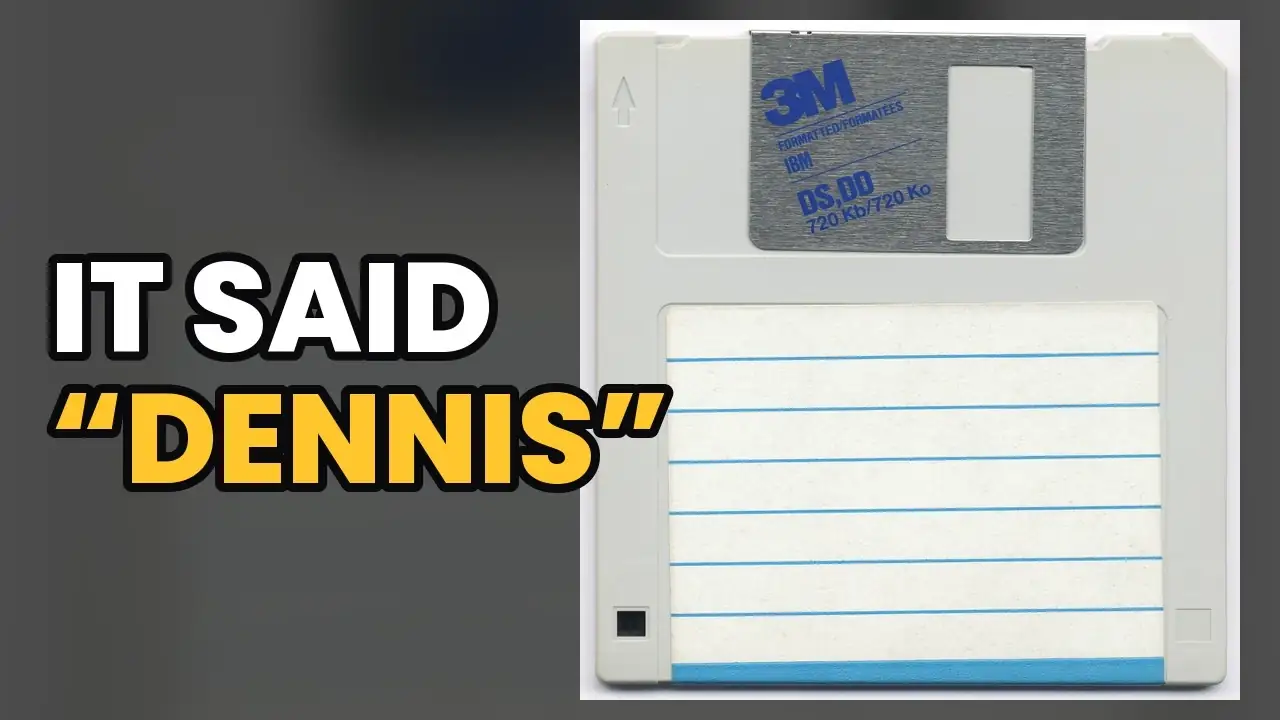
In January 2005 the ad appeared. Rex, it will be OK. A few weeks later, on the sixteenth of February, a purple floppy disk arrived at the Fox television station KSAS.
On it was a single file that said, this is a test. But the disk carried something else: the metadata of a deleted Microsoft Word document.
The document had last been saved by someone named Dennis. And it had been made on a computer at a place called Christ Lutheran Church.
A simple internet search found the church's website, and the website listed the president of its congregation council. Dennis Rader.
The proof
A name was not proof. Investigators obtained a court order for a medical sample taken from Rader's daughter years earlier at a clinic near Kansas State University, and compared her DNA with evidence from three crime scenes.
The result said that whoever BTK was, he was her father. On the twenty-fifth of February 2005, officers stopped Dennis Rader near his home in Park City as he drove home for lunch.
Early in the interview, sitting across from Landwehr and an FBI behaviourist, he said three words. I'm BTK. Landwehr said the floodgates opened after that.
The interview ran for more than thirty hours. The recordings filled seventeen DVDs. Rader himself summed it up. The floppy did me in.
The court
Police found BTK's original communications in a locked filing cabinet in Rader's office at Park City, where he had enforced the town's codes. The city dismissed him within days.
On the twenty-seventh of June 2005, the day his trial was due to begin, Rader pleaded guilty to ten counts of first-degree murder, and confirmed each of them to the judge.
On the eighteenth of August 2005 he was sentenced to ten consecutive life terms, a minimum of one hundred seventy-five years. The next day he was moved to the El Dorado Correctional Facility.
What it changed
The BTK case became a textbook example of two things. First, that a killer's need to be heard can be used against him, if investigators are patient enough to listen.
Second, that a file is never only a file. Every document carries a hidden record of who made it and where. Rader asked whether that record existed, and the people hunting him said no.
The end
Thirty years. Ten victims. Nineteen messages. And a case closed by the kind of detail nobody notices: a name on a deleted file, and a church website that listed who ran the council.